


CPU Cache Is the New Battlefield for Gaming Performance
CPU cache has quietly become one of the most important factors in gaming performance. If you are building or buying a custom gaming PC today, understanding how cache works can make a real difference to frame rates and frame consistency.
If you are researching parts for a custom gaming PC, you have probably seen a familiar debate: more cores or higher clock speed?
For years that was the entire conversation. Gamers compared GHz numbers and core counts when choosing a gaming PC. But modern game engines and modern CPU designs have shifted the performance battleground.
Today, CPU cache is one of the most important factors in gaming performance.
Whether you are building your own system or buying a professionally built custom gaming PC, understanding how cache affects frame rates, latency, and frame pacing can help you choose the right hardware for the games you actually play.
This guide takes a deep technical dive into CPU cache, why modern games depend on it, and how it should influence your choice when configuring a gaming PC in 2026.
What Is CPU Cache?
At a fundamental level, CPU cache exists to solve a massive speed mismatch between the processor and system memory.
Modern CPUs can execute instructions in fractions of a nanosecond, while system memory operates at much higher latency. Accessing data from RAM can take several times longer than retrieving it from cache, often in the region of five to ten times slower depending on the workload.
To prevent the processor from constantly waiting on memory, modern CPUs implement a hierarchy of extremely fast on chip memory layers known as cache. These layers are designed to keep the most frequently accessed data as close to the CPU cores as possible.
The Three Levels of CPU Cache
Understanding how cache works is essential when selecting the processor for a high performance gaming PC build.
L1 Cache
L1 is the fastest and smallest cache level. Each CPU core has its own dedicated L1 cache and it sits extremely close to the execution units inside the processor. Because it is so small, usually only tens of kilobytes, it stores the most frequently accessed instructions and data that the CPU core is actively working with at any given moment.
L2 Cache
L2 cache is larger and slightly slower than L1. It is still typically private to each CPU core and acts as the next layer of storage when the required data cannot be found in L1. Modern desktop CPUs usually include between several hundred kilobytes and a few megabytes of L2 cache per core.
L3 Cache
L3 cache is where things become particularly important for gaming workloads. Unlike L1 and L2, L3 cache is shared between CPU cores. It is significantly larger and often measured in tens or even hundreds of megabytes on modern processors.
Because multiple cores can access the same shared pool of data, L3 cache reduces the need for repeated trips to system memory when threads need access to common information. For many modern game engines, L3 cache capacity has a direct impact on overall performance.
Why CPU Cache Matters for Gaming
Modern games function as large real time simulations. Every frame requires the CPU to process complex sets of data that represent the current state of the game world.
This includes AI behaviour trees, physics calculations, player and NPC state data, world streaming systems, animation blending, and the draw calls that prepare work for the GPU. These data sets are accessed repeatedly across many frames.
If the working set of data fits inside CPU cache, the processor can retrieve information almost instantly. If the CPU constantly needs to access system memory instead, latency increases and execution pipelines are forced to wait.
This is why CPU cache plays such a large role in frame time consistency and minimum FPS, two of the most important factors in how smooth a game actually feels.
Cache Hits vs Cache Misses
One of the most important metrics in CPU architecture is the cache hit rate.
A cache hit occurs when the processor finds the requested data inside cache. A cache miss occurs when the CPU must fetch that data from main system memory.
Because RAM access is far slower than cache access, cache misses introduce delays known as memory stalls. During a stall the CPU pipeline pauses while waiting for data to arrive from memory.
When these stalls occur repeatedly during gameplay they manifest as frame time spikes, inconsistent frame pacing, and weaker minimum frame rates.
Increasing L3 cache capacity improves hit rates because more of the active game data can remain stored on the processor itself rather than being repeatedly pulled from RAM.
Why Minimum FPS Improves With Larger Cache
Average frame rate numbers often look impressive in benchmarks, but minimum frame rates and frame time consistency are far more important for real gameplay.
Large CPU caches reduce the number of times the processor needs to access slower system memory during simulation workloads. This means fewer memory stalls, lower latency when accessing shared data, and a more consistent distribution of work between frames.
In practice, CPUs with larger L3 caches frequently deliver much stronger 1 percent low frame rate results. These improvements translate directly into smoother gameplay.
The effect becomes even more noticeable when running high refresh rate monitors. At 240 Hz a system has just over four milliseconds to produce each frame, so any delay caused by memory latency can quickly appear as visible stutter.
The Rise of Massive L3 Cache in Gaming CPUs
Historically, consumer CPUs shipped with relatively small L3 caches. Earlier desktop processors often included less than a dozen megabytes of shared cache.
As game engines became more complex and simulation workloads expanded, CPU designers began increasing cache sizes to reduce reliance on system memory. Modern gaming focused processors can now include well over one hundred megabytes of L3 cache.
This shift has had a measurable impact on gaming performance, particularly in titles that involve complex world simulation or high refresh rate gameplay.
Stacked Cache Technology
One of the biggest recent developments in CPU design is stacked cache.
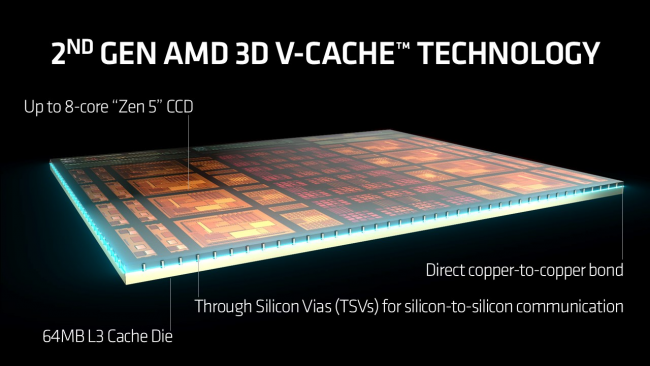
Traditional processors place all cache on the same silicon layer as the CPU cores. Stacked cache introduces an additional SRAM layer that sits vertically on top of the processor die.
The design relies on hybrid bonding, extremely dense vertical interconnects known as through silicon vias, and an additional SRAM layer stacked directly on top of the processor.
The advantage of this approach is simple. It dramatically increases L3 cache capacity without significantly increasing the physical size of the CPU package.
Some modern gaming processors now carry several times the L3 cache of earlier designs, allowing far more game state data to remain directly on the processor.
Why Modern Game Engines Depend on Cache
Several industry trends have made CPU cache far more important than it was even five years ago.
Game worlds have become larger and far more dynamic. Open world titles may simulate thousands of independent entities simultaneously, each with behaviour logic, physics data, and interaction systems that must be evaluated every frame.
At the same time, refresh rates have increased dramatically. Many gaming setups now target 144 Hz or 240 Hz gameplay, which significantly reduces the amount of time the CPU has to prepare each frame.
Finally, modern graphics cards are capable of rendering frames extremely quickly. If the CPU cannot feed them draw calls and simulation updates fast enough, the GPU becomes underutilised, a scenario commonly referred to as a CPU bottleneck.
Large CPU caches help reduce these bottlenecks by allowing the processor to access game data far more efficiently.
Cache vs Clock Speed vs Core Count
When choosing a CPU for a custom gaming PC, three specifications tend to dominate the discussion: clock speed, core count, and cache capacity.
Clock speed influences how quickly individual instructions can be executed and still plays an important role in single threaded workloads. Core count determines how well the processor can distribute tasks across multiple threads.
Cache capacity affects how efficiently those cores access the data they need. Because of this, two processors with similar clocks and core counts can perform very differently in gaming workloads if their cache architectures are significantly different.
Games That Benefit Most From Large Cache
Not every title responds equally to large CPU caches, but certain genres show particularly strong improvements.
Simulation heavy games such as city builders or complex strategy titles often maintain large working data sets that must be accessed repeatedly. Open world games also benefit because the engine must constantly stream world data and maintain state information for many systems simultaneously.
Competitive multiplayer games can also show improvements, especially when players are targeting extremely high frame rates where even small delays become visible.
Choosing the Right CPU for a Custom Gaming PC
When selecting a processor for a modern gaming system, it is worth considering the types of games you spend the most time playing.
Players focused on competitive titles and high refresh rate gameplay often benefit from CPUs with larger caches because they deliver stronger minimum frame rates and smoother frame pacing.
Systems built around powerful graphics cards also benefit from CPUs that can keep the GPU consistently supplied with work. Larger caches help prevent situations where the graphics card is waiting on the processor.
For simulation or strategy players, cache capacity can have an even larger influence because those games frequently operate on very large sets of world data.
The Future of Gaming CPU Design
The direction of processor development suggests that cache will continue to grow in importance.
CPU manufacturers are already exploring designs that use larger stacked cache layers, multi layer cache architectures, and more advanced on package memory systems.
As game engines continue to increase simulation complexity, reducing memory latency will remain a major focus of CPU design.
Final Thoughts
The gaming CPU conversation has changed significantly.
The old question used to be how many cores a processor had and how high it could boost its clock speed.
Today a more useful question is how efficiently that processor can feed data to its cores.
Cache is a major part of that answer.
For anyone researching hardware or configuring a custom gaming PC, understanding how CPU cache influences frame times and simulation workloads is becoming increasingly important.
If you are planning a new system, CPU cache is no longer just a technical detail. It has become one of the defining factors that separates a good gaming system from a truly exceptional one.